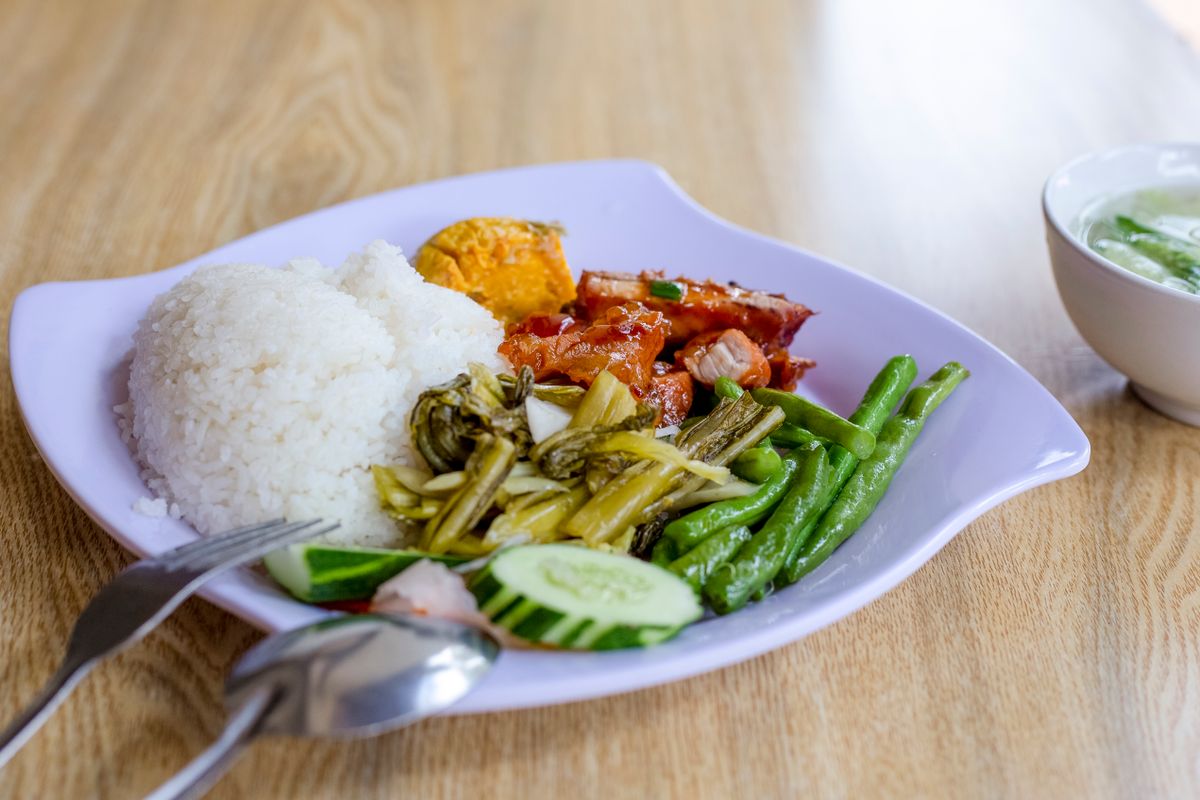
If you eat Korean, Japanese, Chinese, Indian, or Southeast Asian food, "cut the white rice" is advice that asks you to rebuild your entire way of eating around a food that was never the problem. Here's what the numbers actually say.
For the wider menu, pair this with How Many Calories Are in Korean Food? A Full Breakdown and Bibimbap Nutrition Facts: What's Actually in the Bowl.
In this article
How many calories white rice actually has
Cooked white rice runs about 130 calories per 100 g. The number that confuses people is the uncooked figure — dry rice is around 360 kcal per 100 g, because it hasn't absorbed water yet. Rice roughly triples in weight when cooked, so one cup of dry rice becomes about three cups cooked.
This matters when you're logging. Weighing 100 g of dry rice and logging it as "100 g rice" from a cooked-rice entry will underestimate you by around 230 calories. It's one of the most common logging errors there is.
| Portion | Weight | Calories |
|---|---|---|
| Cooked white rice, per 100 g | 100 g | ~130 kcal |
| Korean rice bowl (공기밥, gongibap) | ~210 g | ~270 kcal |
| 1 US cup, cooked | ~158 g | ~205 kcal |
| 2 cups, cooked | ~316 g | ~410 kcal |
| Dry, uncooked white rice | 100 g | ~360 kcal |
For context, 100 g of white bread is roughly 265 kcal and 100 g of potato chips is around 540. Rice sits near the bottom of the staple-carbohydrate range on a per-gram basis, largely because so much of its cooked weight is water. That's the same reason a bowl of it is more filling than the calorie count suggests.
White vs brown rice: the comparison everyone gets wrong
The assumption is that brown rice is the "diet" version. For calories, that's simply not true.
| Per cooked cup | Calories | Fiber |
|---|---|---|
| White rice (~158 g) | ~205 kcal | <1 g |
| Brown rice (~195 g) | ~215 kcal | ~3.5 g |
A cup of brown rice weighs more than a cup of white, so per cup it can come out slightly higher in calories. Per 100 g the two are within a rounding error of each other.
Brown rice does have genuine advantages — more fiber, more magnesium, more B vitamins, and a slower blood-sugar response because the bran is intact. Those are real reasons to eat it. They're nutrition reasons, not weight-loss reasons. Swapping white for brown and changing nothing else will not create a calorie deficit.
Which is good news, because it means the choice is yours to make on taste. If white rice is what makes your meals worth eating — and in Korean cooking it structurally is — keep it.
The portion is the entire story
Rice has one real failure mode, and it isn't nutritional. It's that rice is served by scoop, not by weight, and a scoop is however big the scoop is.
Same food, same plate, double the calories
A standard Korean rice bowl holds about 210 g — roughly 270 calories, and the bowl has a fixed size, so the portion decides itself. A loosely filled dinner plate mounded with rice can easily hit 450 g, which is nearly 600 calories from the base alone. Nothing about the food changed. Only the serving vessel did.
This is why "is white rice bad for weight loss" is the wrong question. Two people can both eat white rice daily and land 300 calories a day apart — that's a difference of roughly 2,100 calories a week, purely from how it was served.
What Korean meals get right about rice
The traditional Korean structure — 밥 (rice), 국 (soup), and 반찬 (side dishes) — happens to be well-built for calorie control, and rice is a working part of that rather than a liability.
- The bowl is standardized. Gongibap portions are consistent by design. Fixed portions beat willpower.
- Rice is the neutral base, not the flavor. Its job is to be eaten against salty, fermented, seasoned sides — so a modest amount goes further than a plain plate of rice would.
- Banchan add volume for very little energy. Seasoned spinach, bean sprouts, radish, and kimchi fill the plate at a fraction of the calories of a starch or a protein.
- Soup adds water weight to the meal. High-water, low-density foods are among the most reliable ways to feel full on fewer calories.
The irony is that Western diet advice often tells people to remove the rice from this structure — which strips out the neutral base and leaves the salty, oily, sugary components eaten on their own. That usually makes the meal worse, not better.
What's actually blowing your budget
If you're eating Korean food and not losing weight, rice is almost never the line item that did it. Compare a 270-calorie bowl against what typically sits next to it:
| Item | Rough calories | Why |
|---|---|---|
| Bowl of rice | ~270 | Mostly water by weight |
| Samgyeopsal (pork belly), one serving | 500–700 | Fat is 9 kcal per gram, and pork belly is mostly fat |
| Yangnyeom fried chicken, a few pieces | 500–800 | Deep-fried, then coated in sugar-based sauce |
| Tteokbokki, one portion | 400–600 | Rice cakes plus a sauce built on sugar and gochujang |
| Cooking oil, 2 tbsp in a stir-fry | ~240 | Invisible, unweighed, and almost never logged |
That last row is the one to sit with. Two tablespoons of oil that vanish into a pan cost nearly as much as the entire bowl of rice you were feeling guilty about — and unlike the rice, you'll never see it on the plate. This is exactly the category of calorie that memory-based logging misses. Snapping a photo of the finished dish with Coach Ivy estimates from what's actually there, oil and sauce included, rather than from what you remember adding.
For the full menu-by-menu breakdown, see Korean BBQ calories and the Korean food calorie guide.
How to keep rice and still lose fat
- Serve it in a bowl, not on a plate. The single highest-leverage change, and it requires no discipline once you've done it.
- Weigh cooked, not dry — or be consistent about which. Mixing the two is a 200+ calorie error per meal.
- Fix the oil before you touch the rice. Measuring cooking oil saves more calories than cutting your rice portion in half, and costs you nothing you enjoy.
- Add a vegetable side before you subtract rice. More banchan means more volume, more fullness, and a naturally smaller appetite for everything else.
- Put protein next to it. Rice alone isn't very satiating; rice with a solid protein portion is. See the protein guide for targets.
- Check the target, not the food. If you're not losing weight, the number to examine is your daily calorie target versus your actual intake — not whether one staple is "allowed."
One small bonus worth knowing about: cooking rice and then refrigerating it increases its resistant starch, a form your small intestine doesn't fully absorb, and reheating retains most of that. The effect is genuine but modest — a few percent, not a transformation. Leftover rice is very slightly friendlier than fresh. Don't build a strategy on it.
Frequently asked questions
Is white rice bad for weight loss?
No. White rice contains about 130 calories per 100 g cooked, which is less calorie-dense than bread, pasta, or almost anything fried. No single food prevents weight loss — only total calories do. The reason rice gets blamed is that it is easy to serve in large amounts and it usually arrives underneath something oily or sugary.
Is brown rice better than white rice for weight loss?
Not for calories. Per cooked cup, brown rice has roughly the same calories as white rice, and sometimes slightly more because it packs denser. Brown rice does have more fiber, around 3 g per cup versus under 1 g, plus more magnesium and B vitamins. Those are good reasons to eat it, but weight loss is not one of them.
How much rice should I eat to lose weight?
There is no universal number, because it depends on your calorie target and what else is on the plate. A useful reference point is the standard Korean rice bowl at roughly 200 to 210 g cooked, about 260 to 275 calories. That is a normal portion for most people. The trouble usually starts around the 2 to 3 cup mark, which is 400 to 600 calories of rice alone.
Does rinsing or cooling rice reduce calories?
Cooling cooked rice does increase resistant starch, a form of starch your small intestine does not fully absorb, and reheating keeps most of that change. The effect is real but small, likely a few percent of the calories rather than a meaningful reduction. It is a minor bonus, not a technique that changes the outcome of your diet.
Why does Korean food include rice with almost every meal?
Korean meals are built as rice plus soup plus banchan side dishes, so rice functions as the neutral base that the seasoned, salty, and fermented sides are eaten against. That structure works in your favor: the vegetable sides add volume and fullness for very few calories, and the standard rice bowl portion is fixed rather than open-ended.
What actually makes Korean meals high in calories?
Almost never the rice. The big contributors are fatty cuts at Korean barbecue such as samgyeopsal, deep-fried dishes like yangnyeom chicken, sugar in tteokbokki and bulgogi marinades, and cooking oil in stir-fried dishes. Those items can add several hundred calories each, while a bowl of rice adds under 300.

Log the whole bowl, oil included
Coach Ivy reads your meal photos and estimates calories and macros from what's actually on the plate — including the sauces and cooking oil that never make it into a manual log. Free on iPhone.
Download Coach Ivy Free