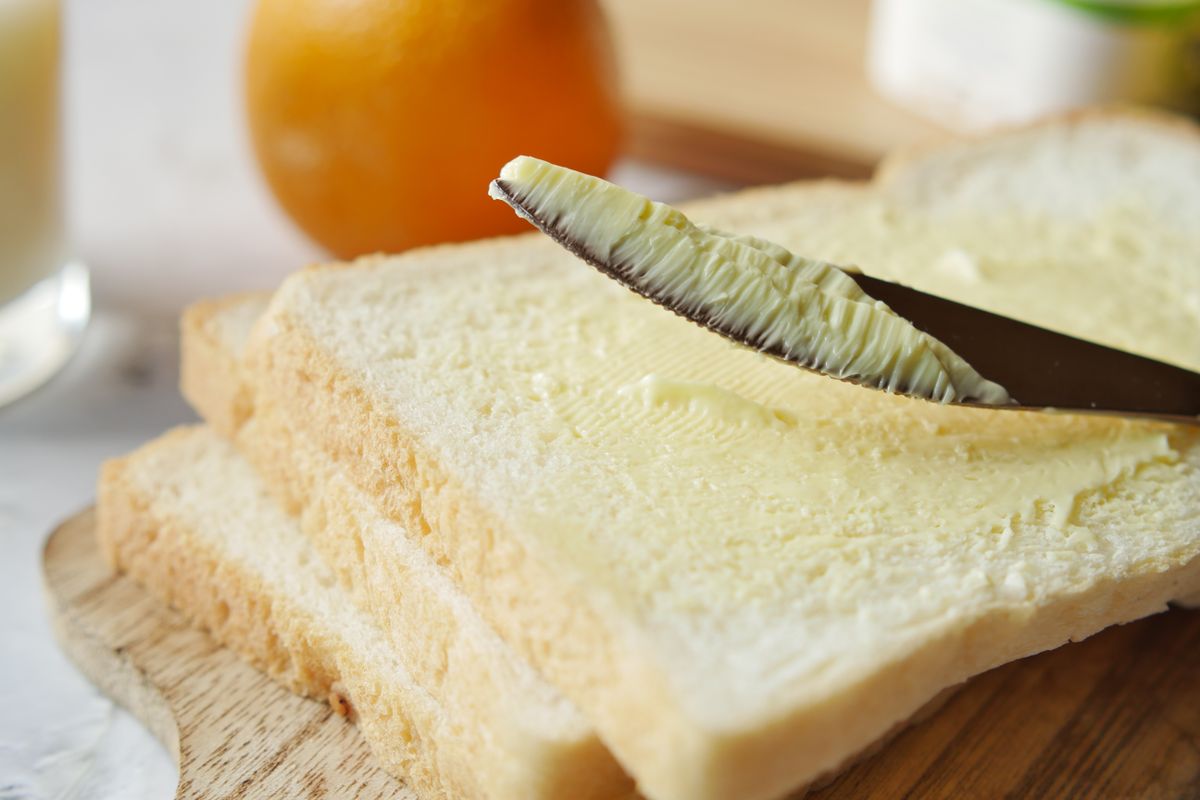
Use the reference table for a quick lookup or enter any amount in the converter. Values are estimates based on about 717 calories per 100g of butter; the number on your package is the best source for a specific brand.
For more portion-aware calorie comparisons, see How Many Calories Are in Grapes? Per Grape, Per Cup, Per 100g.
A knob of butter is a guess. The calories aren't.
Butter runs about 102 calories a tablespoon, so eyeballing a pat by 5g costs you 36. Snap the plate instead and let an AI calorie tracker estimate the butter, the toast and the rest in one shot.
In this article
- Butter serving converter
- Calories by serving size
- Calories by weight in grams
- Calories by tablespoon, cup and stick
- Pat, pad, knob and packet weights
- Salted vs unsalted butter
- Butter vs olive oil
- Butter vs margarine
- Butter used when cooking eggs
- Toast, bagels and rolls with butter
- Is butter healthy?
- Grass-fed butter
- Frequently asked questions
Butter serving and calorie converter
Enter the butter amount you used and choose a unit. The converter shows its estimated weight, calories and tablespoons instantly.
Convert a butter serving
Estimate uses 7.17 calories per gram. Package labels and butter types can vary slightly.
Butter calories by serving size
This consolidated table covers the serving terms most recipes, restaurant menus and calorie trackers use.
| Serving | Weight | Calories | Total Fat | Saturated Fat |
|---|---|---|---|---|
| 1 pat / chip (restaurant portion) | 5g | 36 kcal | 4g | 2.5g |
| 1 teaspoon | 4.7g (⅓ tbsp) | 34 kcal | 3.8g | 2.4g |
| 1 tablespoon | 14.2g | 102 kcal | 11.5g | 7.3g |
| 2 tablespoons | 28.4g | 204 kcal | 23g | 14.6g |
| ¼ stick (2 tbsp) | 28.4g | 204 kcal | 23g | 14.6g |
| ½ stick (4 tbsp) | 56.7g | 405 kcal | 45.5g | 28.9g |
| 1 US stick (8 tbsp) | 113.4g / 4 oz | 810 kcal | 92g | 58g |
| 100g | 100g | 717 kcal | 81g | 51g |
Butter calories by weight in grams
If you weigh butter on a kitchen scale, this is the table you want. Every figure below uses the USDA value for salted butter — 717 kcal per 100g, which works out to 7.17 calories per gram.
| Weight | Calories | Total Fat | Saturated Fat | Common equivalent |
|---|---|---|---|---|
| 1g | 7 kcal | 0.8g | 0.5g | A scrape |
| 3g | 22 kcal | 2.4g | 1.5g | Thin spread on one cracker |
| 4g | 29 kcal | 3.2g | 2.1g | Just under 1 tsp |
| 5g | 36 kcal | 4.1g | 2.6g | 1 restaurant pat |
| 7g | 50 kcal | 5.7g | 3.6g | 1 foodservice packet |
| 8g | 57 kcal | 6.5g | 4.1g | Spread for 1 slice of toast |
| 10g | 72 kcal | 8.1g | 5.1g | Small knob |
| 12g | 86 kcal | 9.7g | 6.2g | Generous toast spread |
| 15g | 108 kcal | 12.2g | 7.7g | Just over 1 tbsp |
| 20g | 143 kcal | 16.2g | 10.3g | Knob for a pan |
| 25g | 179 kcal | 20.3g | 12.8g | ⅒ of a 250g block |
| 30g | 215 kcal | 24.3g | 15.4g | About 2 tbsp |
| 40g | 287 kcal | 32.4g | 20.5g | Roughly 3 tbsp |
| 45g | 323 kcal | 36.5g | 23.1g | Baking portion |
| 50g | 359 kcal | 40.6g | 25.7g | ⅕ of a 250g block |
| 60g | 430 kcal | 48.7g | 30.8g | About 4¼ tbsp |
| 100g | 717 kcal | 81.1g | 51.4g | USDA reference amount |
| 113g | 810 kcal | 91.7g | 58.0g | 1 US stick / 4 oz |
| 115g | 825 kcal | 93.3g | 59.1g | Common EU half-block |
| 170g | 1,219 kcal | 137.9g | 87.3g | 6 oz |
| 200g | 1,434 kcal | 162.2g | 102.7g | Common EU block |
| 250g | 1,793 kcal | 202.8g | 128.4g | Standard UK/EU block |
Need a weight that isn't listed? Multiply the grams by 7.17. So 35g of butter is 35 × 7.17 = 251 calories. Weighing is the only method that removes guesswork — see how to track butter accurately below.
Butter calories by tablespoon, teaspoon, cup and stick
US volume measures are the most-searched way to size butter, so here is every common amount in one place. One US tablespoon of butter weighs 14.2g and contains 102 calories.
| Amount | Weight | Calories | Total Fat | Saturated Fat |
|---|---|---|---|---|
| 1 teaspoon | 4.7g | 34 kcal | 3.8g | 2.4g |
| 2 teaspoons | 9.5g | 68 kcal | 7.7g | 4.9g |
| ½ tablespoon | 7.1g | 51 kcal | 5.8g | 3.6g |
| 1 tablespoon | 14.2g | 102 kcal | 11.5g | 7.3g |
| 1½ tablespoons | 21.3g | 153 kcal | 17.3g | 10.9g |
| 2 tablespoons | 28.4g | 204 kcal | 23.0g | 14.6g |
| 3 tablespoons | 42.6g | 306 kcal | 34.6g | 21.9g |
| 4 tablespoons (¼ cup, ½ stick) | 56.7g | 407 kcal | 46.0g | 29.1g |
| 5 tablespoons | 70.9g | 508 kcal | 57.5g | 36.4g |
| ⅓ cup (5⅓ tbsp) | 75.6g | 542 kcal | 61.3g | 38.8g |
| 6 tablespoons | 85.1g | 610 kcal | 69.0g | 43.7g |
| 8 tablespoons (½ cup, 1 stick) | 113.4g | 810 kcal | 92.0g | 58.2g |
| 1 cup (16 tbsp, 2 sticks) | 226.8g | 1,626 kcal | 184.0g | 116.5g |
810, 814 or 816 calories in half a cup of butter?
All three numbers circulate online, and none of them is wrong — they come from different rounding paths for the same amount of butter:
- 810 kcal — weighing the stick: 113.4g × 7.17 kcal/g. This is the most accurate route.
- 816 kcal — multiplying the rounded tablespoon: 8 × 10² kcal. The 102 is itself rounded up from 101.8, and that error compounds eight times.
- 814 kcal — databases that store a slightly different stick weight (113.5g) or an unrounded per-tablespoon value.
Pat, pad, knob, packet: what each butter portion actually weighs
Recipes and menus use a lot of informal butter words, and calorie trackers rarely define them. Here is what each one weighs in practice.
| Term | Typical weight | Calories | Notes |
|---|---|---|---|
| 1 pat | 5g | 36 kcal | The square served on a restaurant butter dish; roughly 1 tsp |
| 1 pad | 5g | 36 kcal | A common misspelling of "pat" — same thing |
| 2 pats | 10g | 72 kcal | Standard for a bread basket |
| 1 butter packet | 7g | 50 kcal | Sealed foil/plastic foodservice portion; some brands use 8g (57 kcal) |
| 1 knob (UK) | 10–15g | 72–108 kcal | Deliberately imprecise; weigh it if the recipe matters |
| 1 tab | 5g | 36 kcal | Another name for a pat |
| 1 square | 5–7g | 36–50 kcal | Usually a pre-cut portion; check the pack |
| 1 cube (US regional) | 113.4g | 810 kcal | In parts of the western US, "cube" means a whole stick — a 22× difference from a "square". Confirm which is meant. |
| 1 serving (label) | 14.2g | 102 kcal | The FDA reference serving printed on US nutrition labels |
Butter macros — what's actually in it
Butter is essentially a concentrated dairy fat. Its macro profile is as simple as it gets: almost entirely fat, trace amounts of everything else.
| Nutrient | Per 100g | Per 1 tbsp (14.2g) |
|---|---|---|
| Calories | 717 kcal | 102 kcal |
| Total fat | 81.1g | 11.5g |
| — Saturated fat | 51.4g | 7.3g |
| — Monounsaturated fat | 21.0g | 3.0g |
| — Polyunsaturated fat | 3.0g | 0.4g |
| Protein | 0.6g | 0.1g |
| Carbohydrates | 0.1g | 0g |
| Cholesterol | 215mg | 31mg |
| Vitamin A | 684 µg (76% DV) | 97 µg (11% DV) |
| Vitamin D | 1.5 µg | 0.2 µg |
Butter has essentially zero carbohydrates, making it a staple in ketogenic diets. Its protein content is negligible — butter is churned from cream after most of the milk proteins and lactose have been separated off. What remains is fat, water (around 16–18%), and trace micronutrients, particularly vitamin A from the milk fat globules.
Salted vs unsalted butter — same calories, different sodium
One of the most common questions: is salted butter higher in calories than unsalted? The answer is no. The only meaningful difference between salted and unsalted butter is the sodium content.
| Type | Calories per tbsp | Fat per tbsp | Sodium per tbsp |
|---|---|---|---|
| Unsalted butter | 102 kcal | 11.5g | ~2mg |
| Salted butter | 102 kcal | 11.5g | ~90mg |
The salt added to salted butter is typically around 1.6–2% of total weight — enough to make a noticeable flavour difference but not enough to affect calorie count. For calorie tracking, use the same number regardless of which type you're using. If you're watching sodium intake, however, the difference adds up: using 3 tablespoons of salted butter in a recipe adds ~270mg of sodium from the butter alone.
Butter vs olive oil: which has more calories?
Olive oil has more calories by the tablespoon: about 119 calories versus 102 calories in butter. Olive oil is pure fat, while butter also contains water. The 17-calorie difference is small; the amount you pour or spread usually matters more.
| 1 tablespoon | Calories | Total fat | Saturated fat | Main difference |
|---|---|---|---|---|
| Butter | ~102 | 11.5g | 7.3g | More saturated fat; dairy flavour |
| Olive oil | ~119 | 13.5g | 1.9g | Mostly monounsaturated fat; plant-based |
For heart health, the American Heart Association recommends choosing nontropical liquid plant oils, including olive oil, in place of solid fats such as butter more often. That guidance is about the type of fat, not because olive oil is lower in calories. For tracking, measure either one: a free-poured tablespoon of oil is just as easy to underestimate as butter.
Butter vs margarine: are the calories the same?
Regular stick margarine and butter are often close to 100 calories per tablespoon. Soft, whipped and light margarine spreads may contain fewer calories because they include more water. Margarine varies by product, so use its Nutrition Facts label rather than one generic entry.
| Per tablespoon | Typical calories | What to check | Best tracking method |
|---|---|---|---|
| Butter | ~102 | Salted or unsalted; brand variation is small | Log grams or tablespoons |
| Stick margarine | Often ~100 | Saturated fat and partially hydrogenated oils | Use the package label |
| Soft or light spread | Varies widely | Serving size, water content and calories | Use the exact brand entry |
If you are choosing margarine for its fat profile, compare labels. Soft or liquid products made with nonhydrogenated vegetable oil generally contain less saturated fat than butter or hard stick margarine. “Margarine” is a broad category, so the label matters more than the name.
How many calories does butter add when cooking eggs?
One teaspoon of butter adds about 34 calories to fried or scrambled eggs. One tablespoon adds about 102 calories. Two large eggs are about 144 calories before any butter, milk, cheese or toppings are added.
| Two large eggs cooked with | Butter calories | Estimated total |
|---|---|---|
| No added butter | 0 | ~144 calories |
| 1 teaspoon butter (4.7g) | +34 | ~178 calories |
| 2 teaspoons butter (9.5g) | +68 | ~212 calories |
| 1 tablespoon butter (14.2g) | +102 | ~246 calories |
If you eat the whole scramble or wipe up the pan with toast, count all the butter you added. If a visible pool remains, the exact amount consumed is hard to know; logging the full amount is a simple, consistent estimate. See our egg calorie guide for boiled, fried, poached and scrambled eggs.
Calories in toast, a bagel or a roll with butter
A slice of toast with a teaspoon of butter is about 113 calories. A plain bagel with a tablespoon of butter is about 372 calories. Almost all of the variation comes from two things: how big the bread is, and how heavily it is buttered — not from the toasting.
This is where butter actually shows up in most people's day. Nobody eats a tablespoon of butter on its own, so the number that matters is the one for the whole item. The bread is the bigger half of that number, and bread portions vary far more than butter does.
| Item | Bread alone | + 1 tsp butter | + 1 tbsp butter |
|---|---|---|---|
| Slice of toast (white or wholemeal, ~29g) | ~79 | ~113 | ~181 |
| Dinner roll (~28g) | ~87 | ~121 | ~189 |
| Toasted teacake (~60g) | ~190 | ~224 | ~292 |
| Plain bagel (medium, ~98g) | ~270 | ~304 | ~372 |
| Large deli bagel (~131g) | ~360 | ~394 | ~462 |
Does toasting bread add calories?
No. Toasting drives off a little water, so a slice gets very slightly lighter, but no calories are added or destroyed. A toasted slice and an untoasted slice from the same loaf have the same calorie count. What changes is behaviour: warm toast absorbs butter faster and tends to get more of it, which is a real difference of 30 to 70 calories per slice.
The practical takeaway: if you want a lower number, the lever is the butter, not the toaster. Spreading with a teaspoon rather than free-handing it from the tub is the single change that moves it most.
Is butter healthy, or should you avoid it?
Butter is not something you need to avoid, but it is not a health food either. It is roughly 63% saturated fat, and major heart-health guidance is consistent on one point: replacing solid fats like butter with liquid plant oils more often is the change associated with better cardiovascular outcomes. How much you use matters more than whether you use any.
The honest version is duller than either side of the internet argument. Butter is a concentrated fat with a well-understood nutrition profile. A teaspoon on vegetables inside an otherwise varied diet is not the thing determining anyone's health. Several tablespoons a day, on top of an already fat-heavy diet, is a different question — and it is a question about the total, not about butter specifically.
The American Heart Association recommends choosing nontropical liquid plant oils — olive, canola, sunflower — in place of solid fats such as butter, lard and coconut oil where you reasonably can. Note the framing: in place of. Adding olive oil on top of your current butter intake is not the intervention being described.
If you are tracking, the useful reframe is that butter is easy to underestimate and easy to reduce without noticing. Most people who cut their butter calories meaningfully did it by measuring rather than by switching products.
This is general nutrition information, not medical advice. If you are managing cholesterol, heart disease or another condition, your doctor or a registered dietitian should guide what fits your situation.
Grass-fed butter: is it actually different?
Grass-fed butter has the same calories as regular butter — about 102 per tablespoon. It does contain modestly more omega-3 fatty acids, conjugated linoleic acid (CLA), vitamin K2 and beta-carotene, which is what makes it visibly more yellow. Those differences are real, but they are small at the amounts anyone actually eats.
If you are choosing grass-fed butter, choose it for taste, colour or farming preferences. Choosing it expecting a nutritional upgrade will disappoint you: the fat and calorie content is essentially unchanged, and the micronutrient gains are measured in fractions of a daily requirement per tablespoon.
| Per 1 tablespoon (14.2g) | Regular butter | Grass-fed butter |
|---|---|---|
| Calories | ~102 | ~102 |
| Total fat | 11.5g | 11.5g |
| Saturated fat | 7.3g | ~7.0–7.3g |
| Omega-3 | Trace | Modestly higher |
| Beta-carotene | Lower | Higher (deeper yellow) |
For tracking purposes, log grass-fed butter exactly as you would any other butter. If your app offers a separate grass-fed entry, the difference it makes to your daily total is smaller than the error in eyeballing the portion.
How to track butter accurately
Use a kitchen scale, not measuring spoons
A "tablespoon" of butter varies significantly depending on how firm the butter is and how you scoop it. Cold butter from the fridge in a tablespoon measure weighs about 14g. Soft, room-temperature butter mounded in a tablespoon can weigh 18–20g. That's a 40% calorie difference from the same spoon. Weighing on a scale takes 2 seconds and is far more accurate.
Account for butter left in the pan
Butter contains water that can evaporate during cooking, but its calories come mainly from the fat. If you eat everything from the pan, count all the butter you added. If a visible pool remains, there is no reliable way to estimate the exact amount without weighing it, so logging the full amount gives you a simple and consistent upper estimate.
Use the weight in grams, not tablespoons, in your app
Most calorie tracking apps let you enter the amount in grams rather than tablespoons. This is more accurate because the calorie database entries are based on exact weights. Search "butter" and select "100g serving," then type the actual grams you weighed. This avoids the tablespoon measurement ambiguity entirely.
Frequently asked questions
How many calories are in a tablespoon of butter?
One tablespoon of butter (14.2g) contains approximately 102 calories, 11.5g of fat, 0.1g of protein and effectively zero carbohydrates.
How many calories are in a pat of butter?
A standard 5g pat of butter contains approximately 36 calories. Restaurant pats can vary in size, so check the weight when available.
How many calories are in a teaspoon of butter?
One teaspoon of butter weighs about 4.7g and contains approximately 34 calories. Three teaspoons equal one tablespoon, or about 102 calories.
How many calories are in a stick of butter?
One US stick of butter weighs about 113g, equals 8 tablespoons and contains approximately 810 calories.
How many calories are in 50g of butter?
Fifty grams of butter contains approximately 359 calories, 40.6g of total fat and 25.7g of saturated fat. That is about 3½ tablespoons, or one fifth of a standard 250g block.
How many calories are in half a cup of butter — 810, 814 or 816?
All three figures describe the same amount of butter and differ only by rounding. Half a cup is 8 tablespoons or 113.4g. Weighing it gives 113.4 × 7.17 = 810 calories and that is the most accurate figure. Multiplying the rounded per-tablespoon value gives 8 × 102 = 816, because the 102 is itself rounded up from 101.8 and that error compounds. Some databases store 814 from a slightly different stick weight. Use 810 if you weighed it.
Why does one tablespoon of butter show as 102 calories in USDA data?
The USDA lists salted butter at 717 calories per 100g. One US tablespoon weighs 14.2g, so 14.2 × 7.17 = 101.8 calories, which rounds to 102. Some apps display 100 or 101 instead because they round the per-gram value first. The difference is not meaningful for tracking.
What is the difference between a pat, a pad, a knob and a cube of butter?
A pat is the 5g restaurant portion (36 calories), and pad is simply a common misspelling of it. A knob is a British cooking term for roughly 10–15g (72–108 calories) and is deliberately imprecise. A cube is the one to watch: in parts of the western United States it means an entire 113g stick — 810 calories, more than twenty times a pat. If a recipe says "cube", confirm which is meant before logging it.
How many WeightWatchers points is butter?
Butter carries a high points value because it is almost pure fat, but WeightWatchers no longer publishes a single fixed number — values differ by plan and are personalised to each member, and the algorithm has changed several times. Scan the product in the WW app for the current value rather than relying on a figure found online. For reference, a tablespoon is 102 calories and 11.5g of fat.
How many calories are in 100g of butter?
One hundred grams of butter contains approximately 717 calories, 81g of total fat, 0.6g of protein and 0.1g of carbohydrates.
How many calories are in 10g of butter?
Ten grams of butter contains approximately 72 calories. It is about 2 teaspoons or a little under three-quarters of a tablespoon.
Does salted butter have more calories than unsalted butter?
No. Salted and unsalted butter both contain about 102 calories per tablespoon. Salted butter contains much more sodium, and the exact amount varies by brand.
Is butter worse than olive oil for calories?
Butter has fewer calories per tablespoon than olive oil: about 102 calories versus 119. Olive oil is mostly monounsaturated fat while butter is high in saturated fat.
Does butter or margarine have more calories?
Butter and regular stick margarine are often similar at around 100 calories per tablespoon. Soft, whipped and light margarine spreads may be lower, so check the product label.
How many calories does butter add to eggs?
Butter adds about 34 calories per teaspoon or 102 calories per tablespoon. Two large eggs cooked with one teaspoon of butter contain about 178 calories in total.
Does melted butter have more calories?
No. Melting butter does not create calories. The same weight has essentially the same calories before and after melting.
How many calories are in toast with butter?
One slice of toast with a teaspoon of butter is about 113 calories — roughly 79 from the bread and 34 from the butter. With a full tablespoon of butter it is about 181 calories. Toasting itself adds no calories.
How many calories are in a bagel with butter?
A medium plain bagel (about 98g) with one tablespoon of butter is roughly 372 calories. A large deli bagel with the same butter is closer to 462 calories, because the bagel size varies far more than the butter does.
Is grass-fed butter healthier than regular butter?
Grass-fed butter has the same calories as regular butter, about 102 per tablespoon, and nearly the same fat profile. It contains modestly more omega-3, CLA, vitamin K2 and beta-carotene, but the amounts are small per tablespoon. Choose it for taste or farming preference rather than for a nutritional upgrade.

Snap your meal — let Ivy handle the butter math
Coach Ivy's AI reads your food photos and estimates portions — including hidden fats like butter in sauces and cooking. Free on iPhone.
Download Coach Ivy Free