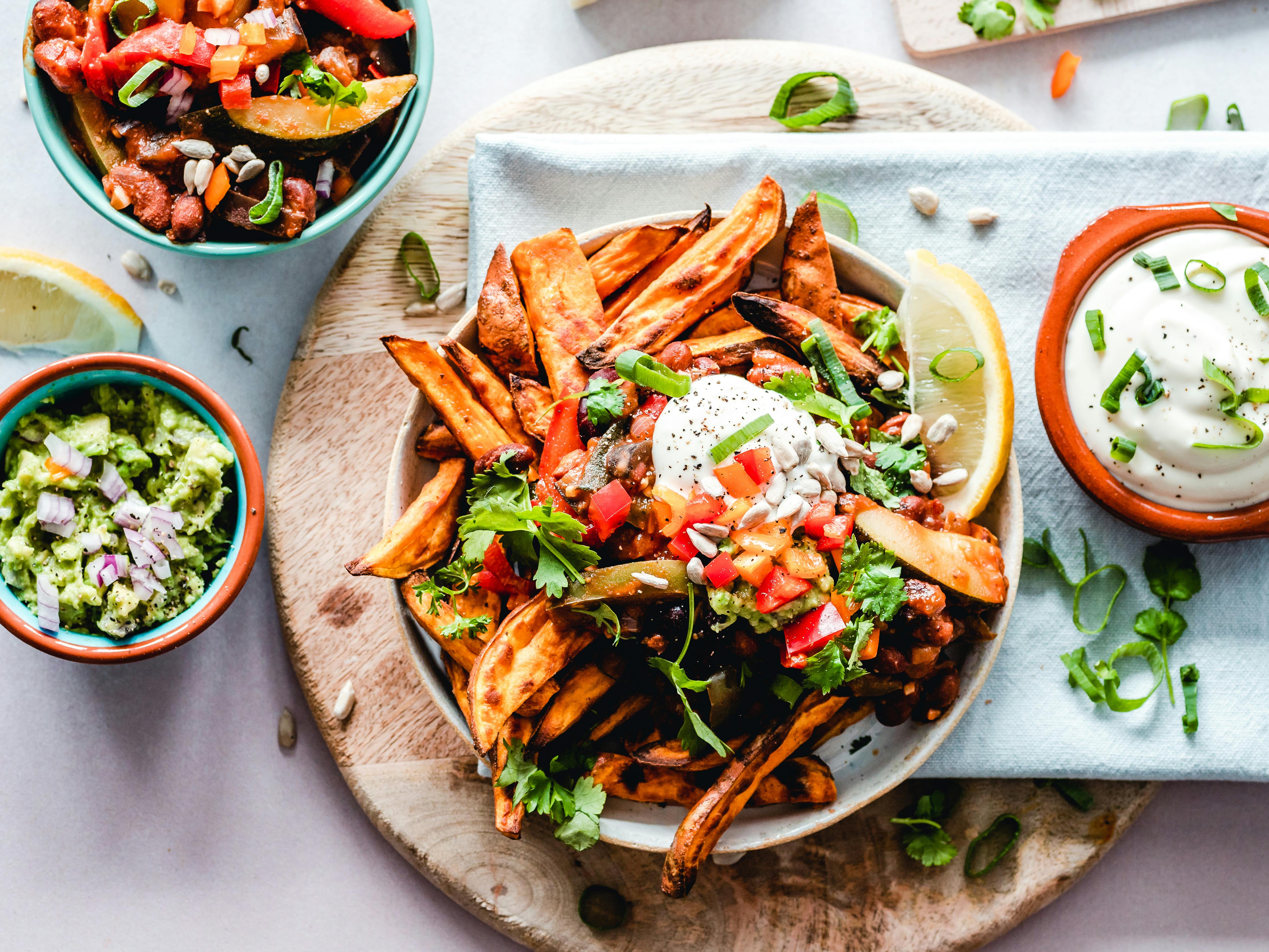
MyPlate works because it skips the math. You don't count grams of carbs or grams of protein — you fill half the plate with produce, a quarter with grains, a quarter with protein, and add a serving of dairy on the side. The calorie calculator just tells you how big the plate should be.
In this article
What MyPlate actually is
MyPlate is the USDA's nutrition graphic that replaced the food pyramid in 2011. It's a literal dinner plate split into four wedges — fruits, vegetables, grains, protein — plus a small circle for dairy. The idea is simpler than the pyramid: instead of remembering "6–11 servings of grains a day," you just look at your plate.
The MyPlate plan is the personalised version. You enter age, sex, height, weight, and activity level, and the official calculator at myplate.gov returns a daily calorie target plus serving amounts in each food group. It's based on the 2020–2025 Dietary Guidelines for Americans, the same evidence base used by registered dietitians.
How the MyPlate calorie calculator works
Under the hood, the calculator is a slightly simplified Mifflin-St Jeor equation — the same BMR formula used in most calorie apps — multiplied by an activity factor:
- Estimate BMR (resting calories) from sex, age, height, and weight.
- Multiply by activity level: sedentary ×1.2, moderate ×1.4–1.55, active ×1.6–1.75.
- Round to a 200-kcal bracket (1,600, 1,800, 2,000, 2,200, 2,400, 2,600, 2,800, 3,000) — this makes the plan portable across pre-built sample menus.
- Assign servings per food group from a lookup table tied to that calorie bracket.
So the calculator isn't really computing the perfect calorie count to the kilocalorie — it's bucketing you into a standard plan and giving you the matching portion sheet. That's a feature, not a bug: it's easier to follow "2 cups fruit" than "1.83 cups fruit."
Daily calorie targets by age & activity
Here are the official MyPlate calorie buckets for adults, adapted from the USDA Dietary Guidelines:
| Group | Sedentary | Moderately Active | Active |
|---|---|---|---|
| Women 19–30 | 2,000 kcal | 2,000–2,200 | 2,400 kcal |
| Women 31–50 | 1,800 kcal | 2,000 kcal | 2,200 kcal |
| Women 51–60 | 1,600 kcal | 1,800 kcal | 2,000–2,200 |
| Women 61+ | 1,600 kcal | 1,800 kcal | 2,000 kcal |
| Men 19–30 | 2,400 kcal | 2,600–2,800 | 3,000 kcal |
| Men 31–50 | 2,200 kcal | 2,400–2,600 | 2,800–3,000 |
| Men 51–60 | 2,200 kcal | 2,200–2,400 | 2,400–2,800 |
| Men 61+ | 2,000 kcal | 2,200–2,400 | 2,400–2,600 |
The 5 food groups — daily targets
Here is what each MyPlate calorie bracket translates to in food-group servings. These are total amounts for the whole day, not per meal:
| Calorie target | Fruits | Vegetables | Grains | Protein | Dairy |
|---|---|---|---|---|---|
| 1,600 kcal | 1.5 cups | 2 cups | 5 oz | 5 oz | 3 cups |
| 1,800 kcal | 1.5 cups | 2.5 cups | 6 oz | 5 oz | 3 cups |
| 2,000 kcal | 2 cups | 2.5 cups | 6 oz | 5.5 oz | 3 cups |
| 2,200 kcal | 2 cups | 3 cups | 7 oz | 6 oz | 3 cups |
| 2,400 kcal | 2 cups | 3 cups | 8 oz | 6.5 oz | 3 cups |
| 2,600 kcal | 2 cups | 3.5 cups | 9 oz | 6.5 oz | 3 cups |
| 2,800 kcal | 2.5 cups | 3.5 cups | 10 oz | 7 oz | 3 cups |
| 3,000 kcal | 2.5 cups | 4 cups | 10 oz | 7 oz | 3 cups |
Notice that dairy stays at 3 cups across every bracket — the variable groups are produce, grains, and protein. Notice also that "ounces" of grains and protein are ounce equivalents, not raw weight. One slice of bread is a 1 oz equivalent even though it weighs less than that.
What one serving actually looks like
MyPlate uses cup equivalents and ounce equivalents instead of raw weights. Here's how the conversions work for common foods:
| Group | 1 serving equals | Approx. calories |
|---|---|---|
| Fruits | 1 medium apple · 1 cup berries · ½ cup dried fruit · 1 cup 100% juice | ~60–100 kcal |
| Vegetables | 1 cup raw leafy greens · ½ cup cooked vegetables · 1 cup vegetable juice | ~25–50 kcal |
| Grains | 1 slice bread · ½ cup cooked rice/pasta/oats · 1 cup cereal flakes · 1 small tortilla | ~70–110 kcal |
| Protein | 1 oz cooked meat/poultry/fish · 1 large egg · ¼ cup cooked beans · 1 tbsp nut butter · ½ oz nuts | ~50–100 kcal |
| Dairy | 1 cup milk · 1 cup yogurt · 1.5 oz hard cheese · 2 cups cottage cheese | ~80–150 kcal |
"Half a cup" is smaller than people think
A typical restaurant portion of rice or pasta is 1.5–2 cups — that's 3–4 grain servings in one meal. A small home bowl of oatmeal is closer to a single ½-cup serving. If you've ever finished a MyPlate-style meal feeling hungry, it's usually because the produce was undersized, not because the plan is wrong.
A sample 2,000 kcal MyPlate day
The 2,000 kcal plan calls for 2 cups fruit, 2.5 cups vegetables, 6 oz grains, 5.5 oz protein, and 3 cups dairy. Here is one realistic way to hit it:
| Meal | What's on the plate | Food group hits |
|---|---|---|
| Breakfast (~450 kcal) | 1 cup oatmeal with 1 cup berries, 1 tbsp peanut butter, 1 cup milk | 1 fruit · 2 grains · 1 protein · 1 dairy |
| Lunch (~550 kcal) | Grilled chicken salad: 2 cups greens, ½ cup cherry tomatoes, 3 oz chicken, vinaigrette, 1 small whole-grain roll, side apple | 1 fruit · 1.5 vegetables · 1 grain · 3 protein |
| Snack (~250 kcal) | Greek yogurt (1 cup) with ¼ cup almonds | 1 dairy · 1.5 protein |
| Dinner (~650 kcal) | Salmon (3 oz cooked) with ¾ cup brown rice, 1 cup roasted broccoli, 1 cup milk | 1 vegetable · 3 grains (~) · 0 — wait, salmon counts |
| Day totals | ~1,950 kcal · 2 fruit · 2.5 veg · 6 grain · 5.5 protein · 3 dairy ✓ | |
Tracking a MyPlate plan in a calorie app
MyPlate is a meal-planning template; a calorie tracker is the daily reality check. The two work well together — MyPlate keeps the food groups balanced, the tracker keeps the totals honest.
Log your serving sizes, not just the food name
"Apple" in a database can be anything from 50 to 150 kcal depending on size. MyPlate cup-equivalents map roughly to USDA medium fruits, so logging "1 medium apple" or "1 cup berries" gets you close. For grains and protein, log the cooked weight in grams — it's the only way to compare across recipes.
Use the AI photo logger for mixed plates
A MyPlate-style dinner — grilled fish, two veg, rice — is exactly the kind of meal manual logging struggles with. Photo-based calorie counters identify all the components at once and estimate the calorie split, which is faster than entering five separate items.
Check food-group ratios weekly, not daily
A single day rarely hits every group on target. Look at a rolling 7-day view: are you averaging 2 cups fruit a day? 2.5 veg? If yes, the plan is working even if Tuesday was light on vegetables. This is more sustainable than trying to perfectly balance every plate.
Frequently asked questions
How does the MyPlate calorie calculator work?
It estimates your daily calorie needs using age, sex, height, weight, and activity level (a simplified Mifflin-St Jeor equation), then rounds the result into a standard 200-kcal bracket and looks up the matching food-group serving sizes. The output is a daily plan like "2,000 kcal — 2 cups fruit, 2.5 cups vegetables, 6 oz grains, 5.5 oz protein, 3 cups dairy."
Is MyPlate good for weight loss?
MyPlate isn't a weight-loss plan by default — it's a balanced eating template. To adapt it for weight loss, find your maintenance calorie target on the calculator, then drop 250–500 kcal a day while keeping the food-group ratios the same. The structure (half the plate produce, a quarter grains, a quarter protein) naturally lowers calorie density without restricting any food group entirely.
How many calories should a woman eat on MyPlate?
Most adult women fall between 1,600 and 2,400 kcal. A sedentary woman in her 30s lands around 1,800 kcal/day. An active woman in her 20s lands around 2,400 kcal/day. The MyPlate calculator computes your specific number using your height, weight, and activity level.
What is one serving in MyPlate?
MyPlate uses two units: cup equivalents for fruits, vegetables, and dairy, and ounce equivalents for grains and protein. Examples: 1 cup raw leafy greens = 1 cup equivalent of vegetables. ½ cup cooked rice = 1 oz equivalent of grains. 1 large egg = 1 oz equivalent of protein. 1 cup milk = 1 cup equivalent of dairy.
Does MyPlate work for older adults?
Yes — there's a dedicated MyPlate for Older Adults variation that emphasises hydration, vitamin B12, calcium, vitamin D, and easier-to-chew protein sources. The calorie targets are lower (most adults over 60 sit between 1,600 and 2,200 kcal), and the protein recommendation is slightly higher per kilogram of bodyweight to protect muscle mass.
Where can I take the MyPlate quiz?
The official MyPlate quizzes live on myplate.gov (formerly choosemyplate.gov). They cover food groups, serving sizes, and label literacy. The MyPlate plan calculator on the same site personalises a daily plan for you in under a minute.

Snap your plate — let Ivy count the groups
Coach Ivy's AI reads your MyPlate-style meals from a photo, estimates portions for each food group, and keeps your daily calories on target. Free on iPhone.
Download Coach Ivy Free