
You can keep a useful estimated diary without weighing every meal. Start with information you have: a package label, a household measure, a restaurant description or a clear photo. Then check the food and serving before saving. The aim is a repeatable record whose uncertainty you understand.
A practical snap, review, edit and save workflow
- Capture the meal before you start. Keep the plate visible in even light. A photograph is a reminder of what you ate as well as an input for an estimate.
- Check the suggested foods. A similar-looking ingredient can have a different nutrition record. Notice the cooking method and whether a sauce or topping has been included.
- Review the amount. Compare the entry with the part of the plate you ate, the package serving or a household measure you used. Add known details using the correction controls available in your current app version.
- Account for extras once. Review oil, dressing, cheese, drinks and toppings. Check what the existing entry already includes before adding more.
- Save, then correct leftovers. If you ate only part of the serving, adjust the recorded amount. Keep uncertainty visible in your own notes when the exact recipe is unknown.
In Coach Ivy, a photo starts the estimate. Its listing also describes voice, barcode and food-label input, so the camera does not have to solve every meal. For dedicated manual-entry controls, check the current version; those controls are not specified in the public listing.
A photo estimate versus a manually reviewed entry
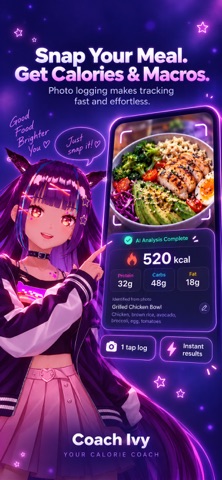
Use the photo to start; use your knowledge to review
The preview shows a grilled chicken bowl. Before saving your own bowl, check the base, chicken preparation, avocado, vegetables and dressing. The image alone cannot establish each ingredient’s weight.
| Photo starting point | Manual review or known detail |
|---|---|
| A bowl with chicken, grains and vegetables | Confirm the grain and cooking method against what you ordered or prepared. |
| A suggested portion | Use the package amount, serving utensil or share of the bowl you actually ate. |
| Dressing is hard to see | Include a known dressing amount if it is missing. If unknown, keep it as an estimate. |
| A calorie and macro total | Review the underlying foods and portions. No independent “correct” number is established by this illustration. |
This comparison illustrates a review process. It does not claim that manual guessing is a measurement, or that one app is more accurate than another. Read the photo counter workflow and photo-estimate limitations for more context.
Use labels and household measures when available
For packaged food, check both the label’s serving size and the number of servings you ate. A label serving is not automatically the amount on your plate. Use a barcode or food-label scan, then review the matched product and serving. For a drink, account for milk, sugar and toppings as well as the base.
A cup, spoon or standard package portion can make repeated meals easier to describe, but it is still an approximation when fullness, density or the recipe changes. Avoid assigning one universal gram weight to “a bowl,” “a handful” or “one scoop.” Use the same reference for a familiar meal, then adjust when the actual portion changes.
Homemade meals and shared recipes
When you know the recipe, start with the ingredients and cooking amounts. Include the cooking fat in the whole recipe, then allocate the share you ate. Do not add the full pan’s butter to each plate. If portions are unequal, “one serving” needs an explicit share rather than assuming every plate is identical.
For a curry, soup or mixed rice dish you did not prepare, a photo cannot reveal the complete recipe. Describe the main ingredients you know and check whether the chosen diary entry already includes sauce or oil. Use one plausible recipe match consistently; avoid treating its nutrition as the exact recipe in front of you.
Our butter serving converter shows how a known cooking amount changes a batch. A full recipe calculator is not yet available on this site; do not substitute the daily macro calculator, which estimates daily targets rather than a recipe’s nutrition.
Restaurants, takeout and mixed plates
Use the restaurant’s nutrition information when it applies to the item and serving you ordered. Customizations, shared dishes and leftovers can change that match. Keep a photo or order description so you can review bread, rice, sides, drinks and condiments together.
If the restaurant does not publish nutrition, use the available description and a comparable food record. Treat a heavily sauced mixed dish as more uncertain than a labeled packaged food. A second scan is not proof of accuracy: two similar estimates can share the same missing ingredient.
Sauces, oils and portion corrections
Ask whether a sauce is already part of the recognized dish. Add a separate ingredient only when you know it is missing. For oil used in a shared pan, the amount added and the amount actually eaten can differ; do not assume the camera can measure absorption or leftovers in the pan.
For a portion correction, change the underlying amount where the app allows it rather than adjusting only a calorie total. That keeps protein, carbohydrate and fat tied to the food entry. If the current app cannot represent the detail you need, choose a measured-food or recipe workflow that can.
A routine for uncertain meals
- Record the best available description while you remember it.
- Keep known ingredients separate from unknown cooking details.
- Use a consistent reference for meals you repeat.
- Correct an entry when you later get a label or recipe.
- Use measured ingredients or qualified nutrition guidance when your situation requires more precision.
A diary can support awareness without promising clinical precision. If calorie tracking feels distressing or you need medical nutrition advice, an appropriate professional can help choose a suitable approach.
Frequently asked questions
Can I count calories without a food scale?
Yes, you can keep an estimated food diary using package servings, household measures, meal descriptions and reviewed photos. Your totals will be less certain when portions or recipes are unknown. A scale is useful when you need a measured ingredient amount.
Can a photo tell me exactly how many calories I ate?
No. A single photo cannot weigh food or reveal every oil, sauce or ingredient. Check the identified foods and portions and add information you know about the meal.
How do I log a homemade mixed dish?
Separate the ingredients you know, include cooking fats and toppings, and record the share you ate. If you do not know the recipe or finished quantity, keep the entry as an estimate rather than claiming exact nutrition.
Should I add oil separately after scanning a meal?
Check the entry first. Add known oil only if it is missing, so you do not count the same ingredient twice. If you do not know how much was used or retained, record that uncertainty.
Does Coach Ivy support voice and barcode logging?
Its current iPhone App Store listing describes voice, photo, barcode and food-label inputs. Check the current in-app offer for feature access. The public listing does not specify all ongoing free-use limits.
Coach Ivy currently offers a two-week trial. Check the purchase screen for eligibility, included features, renewal price and billing period before starting. Ongoing free access after the trial is not established here.
For choosing and comparing portions before a meal, use our visual portion-control guide and checklist. To turn a daily record into macro totals, follow the macro tracking tutorial.