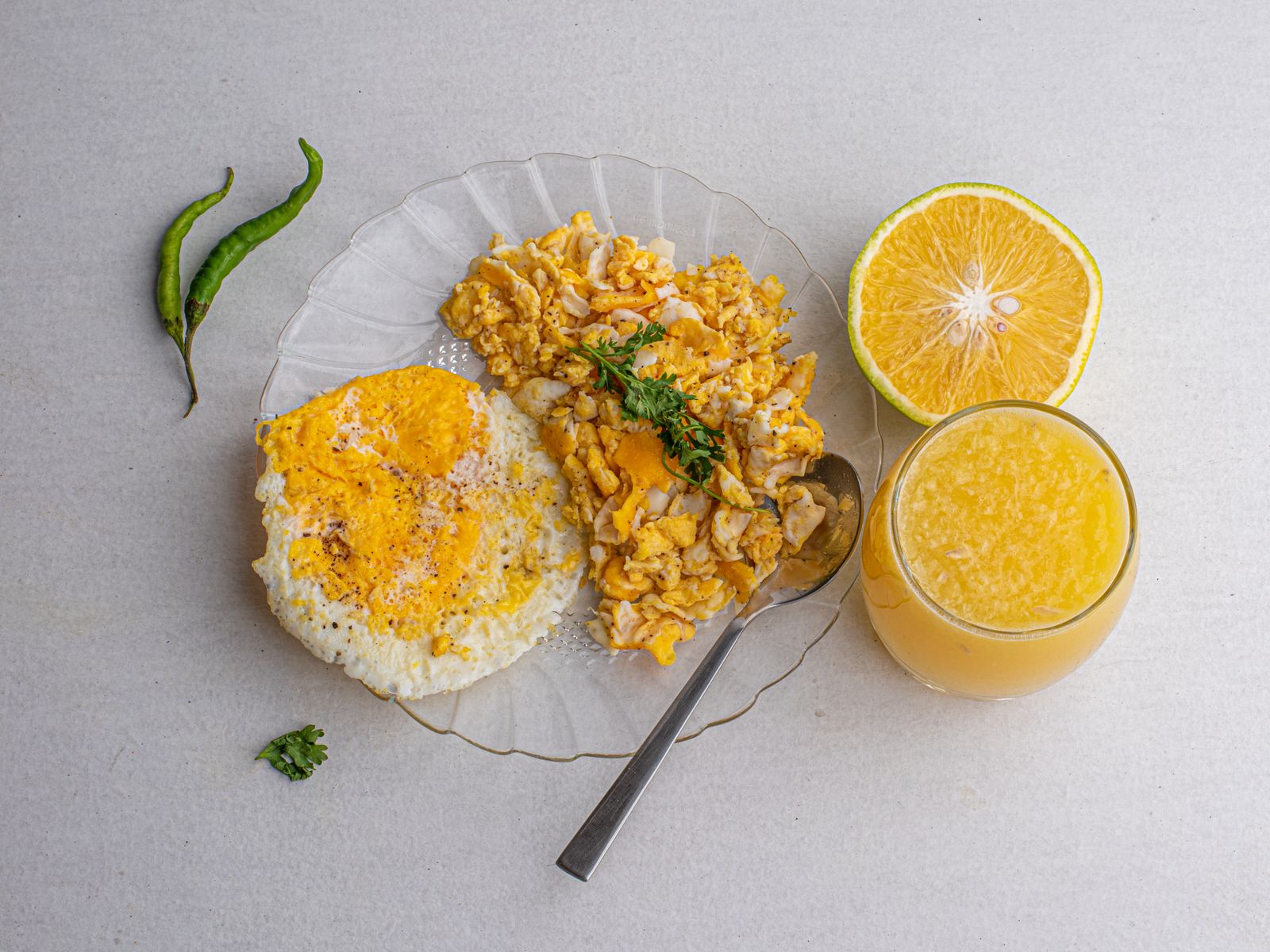
The short answer: one large egg has 72–78 calories with nothing added. Everything after that depends on how much fat you cook with. This guide breaks down every popular preparation method with exact numbers so you can log eggs accurately — no guessing.
In this article
Egg nutrition basics — what's inside a large egg
Before looking at preparation methods, understand what you're starting with. One large egg (50g edible, without shell) contains:
| Nutrient | Whole egg | Yolk only | White only |
|---|---|---|---|
| Calories | 72–78 kcal | 55 kcal | 17 kcal |
| Protein | 6.3g | 2.7g | 3.6g |
| Fat | 5g | 4.5g | 0.1g |
| Carbohydrates | 0.6g | 0.6g | 0.2g |
| Cholesterol | 186mg | 184mg | 0mg |
The yolk holds nearly all the fat, cholesterol, vitamin D, vitamin B12, and choline. The white is almost pure protein with trace fat. This split matters for tracking because almost every calorie difference between cooking methods comes from added fat, not from the egg changing chemically.
Calories by egg size
Egg size is graded by weight. When a recipe says "large egg" it typically means the USDA large grade (50g). Here's the full breakdown:
| Size | Weight (w/o shell) | Calories | Protein | Fat |
|---|---|---|---|---|
| Peewee | ~35g | 54 kcal | 4.5g | 3.7g |
| Small | ~38g | 54 kcal | 4.8g | 3.8g |
| Medium | ~44g | 63 kcal | 5.5g | 4.4g |
| Large (standard) | ~50g | 72–78 kcal | 6.3g | 5g |
| Extra Large | ~56g | 80 kcal | 7g | 5.6g |
| Jumbo | ~63g | 90 kcal | 7.9g | 6.3g |
All calorie counts for preparation methods below use one large egg (50g) as the baseline unless noted. Scale up or down proportionally for other sizes.
Every preparation method, ranked lowest to highest
The rule of thumb: if you add no fat, you add no calories. Every teaspoon of butter adds ~34 kcal. Every teaspoon of olive oil adds ~40 kcal. That's what separates a poached egg from a fried one.
Egg white only (raw or cooked)
The purest calorie trade on this list. One large egg white is almost entirely protein with virtually zero fat. Bodybuilders and cutting dieters have leaned on egg whites for decades for exactly this reason — 3.6g protein at 17 kcal is exceptional efficiency.
Cooked whites (scrambled, pan-fried without fat) contain the same calories as raw. The method doesn't change anything; only added ingredients do.
Poached egg
Poaching uses no added fat — the egg cooks entirely in simmering water. This makes poached eggs the lowest-calorie way to eat a whole egg. The calorie count is essentially identical to a raw egg: just the egg itself, nothing more.
A splash of white vinegar in the poaching water (the standard trick for keeping the white together) adds zero measurable calories.
Hard boiled egg
Hard boiled eggs come in at 78 kcal — slightly more than the raw figure because some water evaporates during cooking, concentrating the remaining nutrients slightly. The difference is minor (a few calories at most). No fat is added, so this remains one of the cleanest whole-egg options.
Hard boiled eggs are the meal prep champion: cook a batch on Sunday, grab one throughout the week. High satiety, portable, and one of the best protein-per-calorie options in any food category.
Soft boiled egg
Soft boiled and hard boiled are nearly identical in calories. The only difference is cook time (6 minutes vs. 12 minutes for large eggs from boiling water). The runny yolk in a soft boiled egg isn't nutritionally different from a set yolk — it's the same fat and protein, just less denatured.
Soft boiled eggs are increasingly popular for ramen and grain bowls. When logging a ramen bowl, add the egg separately as "soft boiled egg, large" and don't let it get absorbed into a generic "ramen" entry if you want accuracy.
Microwave scrambled (no added fat)
Microwaving a beaten egg in a mug with nothing added keeps you at the egg's baseline calories. It's the fastest no-fat scramble: beat 1–2 eggs, microwave 60–90 seconds, stir halfway through. Texture isn't restaurant-quality, but the calorie count is the most honest version of scrambled eggs possible.
Sunny-side up — nonstick, no butter
A nonstick pan with a light spray of cooking oil (roughly half a second of spray = ~7 kcal) keeps a sunny-side up egg around 85–95 kcal. The yolk stays runny, the white sets, and the calorie overhead from cooking is minimal.
If you use a stainless or cast iron pan without any fat, you'll end up with a stuck egg and some frustration. A brief cooking spray is worth it and negligible in calories.
Over-easy / over-medium / over-hard with 1 tsp butter
One teaspoon of butter (4g) adds 34 kcal, pushing a fried egg to around 101–110 kcal depending on the egg size. Whether it's over-easy (runny yolk), over-medium (jammy yolk), or over-hard (fully set), the calorie difference between these styles is zero — it's just cook time. The butter is the variable.
Restaurant fried eggs typically use more than 1 tsp of butter — closer to 1 tablespoon (3 tsp = 102 extra kcal). A diner fried egg is realistically 145–160 kcal per egg, not 100.
Scrambled with butter and splash of milk (1 egg)
The classic scrambled egg method — beaten egg, 1 tsp butter, 1 tablespoon of whole milk — lands around 110–115 kcal per large egg. The butter adds 34 kcal and the milk adds ~9 kcal per tablespoon. If you cook 2 eggs this way (the normal serving), expect 220–230 kcal.
Gordon Ramsay–style scrambled eggs (low-and-slow with butter, cream, and repeated resting) can use a full tablespoon of butter per egg and a knob of crème fraîche — these land closer to 180–200 kcal per egg. Beautiful, but not light eating.
Basted egg (water-basted)
Basting uses a splash of water in the hot pan to steam the top of the egg white without flipping, giving you a set white and a runny yolk without the greasiness of a flipped fried egg. With just a light oil coating (or butter-basted, which is richer), it's calorie-equivalent to a light fry.
Water-basted: ~85–95 kcal. Butter-basted (where you tilt the pan and spoon hot butter over the top): add 34–68 kcal per teaspoon to tablespoon of butter used.
Plain omelet — 2 eggs + 1 tsp butter
A standard 2-egg omelet with 1 tsp butter comes to around 185–200 kcal before any fillings. This is the base you work from when choosing what to add. Fillings are where omelets get expensive calorie-wise.
The French technique (3 eggs, 1 tbsp butter, no browning) runs closer to 280–300 kcal for the egg-and-butter portion alone.
Calories in common egg dishes
When eggs go into composed dishes, the other ingredients take over as the primary calorie driver. Here are realistic estimates for the dishes people search most:
| Dish | Serving | Calories | Notes |
|---|---|---|---|
| Eggs Benedict | 2 eggs + English muffin + Canadian bacon + hollandaise | ~700 kcal | Hollandaise sauce alone is ~150–200 kcal per 2 tbsp |
| Shakshuka (tomato-poached eggs) | 2 eggs in sauce (no bread) | ~280 kcal | Depends on olive oil used in the sauce |
| Deviled eggs | 2 halves (1 whole egg) | ~120–140 kcal | Mayo adds ~60–80 kcal per 2 halves |
| Frittata | 1 slice (⅙ of 6-egg frittata) | ~130–160 kcal | Varies heavily with cheese and fillings |
| Egg fried rice | 1 cup | ~350–450 kcal | Rice and oil are the main calorie sources |
| Breakfast burrito (2 eggs) | 1 large burrito | ~500–700 kcal | Tortilla, cheese, and sausage drive this number |
| Hard boiled egg salad (2 eggs) | ½ cup | ~200–280 kcal | Mayo (1–2 tbsp) adds 90–180 kcal |
| Quiche Lorraine | 1 slice (⅛ of 9-inch) | ~380–420 kcal | Pastry crust and heavy cream dominate |
The real variable: fat, not the egg
If there's one thing to take from this guide, it's that the egg itself barely changes based on how you cook it. A large egg is always ~72–78 kcal. What changes the total is what you cook it in and what you add to it.
- 1 tsp butter = +34 kcal
- 1 tbsp butter = +102 kcal
- 1 tsp olive oil = +40 kcal
- 1 tbsp whole milk = +9 kcal
- 30g cheddar cheese = +120 kcal
- Cooking spray (1 sec) = +7 kcal
Poach or boil if you want the egg's calories with nothing added. Add fat intentionally and measure it if you want accuracy. The rest takes care of itself.
Tracking eggs with an AI calorie tracker
Photo-based calorie trackers like Coach Ivy can recognize eggs from photos and estimate prep method — particularly useful when eating out and you can't easily weigh your food. For cooked-at-home eggs, manual logging with a kitchen scale for butter gives you the most accurate result.
Frequently asked questions
How many calories are in a large egg?
One large egg (50g, without shell) contains 72–78 calories, 6.3g of protein, 5g of fat, and less than 1g of carbohydrates. The yolk alone accounts for about 55 kcal, and the white for about 17 kcal.
Does cooking method change egg calories?
Yes — significantly. The egg itself stays at 72–78 kcal regardless of how you cook it. What changes is the added fat. Poaching or boiling adds zero calories. Frying in 1 tsp butter adds ~34 kcal. Scrambling with 1 tsp butter and milk adds ~35–40 kcal. A tablespoon of butter (common in restaurant cooking) adds ~100 kcal per egg served.
How many calories are in 2 scrambled eggs?
Two large scrambled eggs made with 1 tsp butter and 1 tbsp whole milk contain approximately 200–225 calories, 12.5g protein, 16g fat, and 2g carbohydrates. Restaurant scrambled eggs typically use more butter and run closer to 250–320 kcal for two eggs.
Are boiled eggs good for weight loss?
Yes. Hard boiled or soft boiled eggs are one of the most calorie-efficient high-protein foods available. One large hard boiled egg delivers 6.3g of protein at just 78 kcal with no added fat. Studies consistently show high-satiety scores for eggs at breakfast — people tend to eat fewer calories later in the day when eggs are included in the morning meal.
How many calories are in an egg yolk vs. egg white?
The yolk of one large egg contains approximately 55 kcal, with 4.5g fat and 2.7g protein. The white contains approximately 17 kcal, with 3.6g protein and almost no fat. Nearly all of the egg's fat, cholesterol, vitamin D, vitamin B12, and choline are in the yolk — so dropping yolks removes most of the micronutrient value, not just the fat.
How many calories in an omelette?
A plain 2-egg omelet made with 1 tsp butter contains approximately 185–200 calories. A 3-egg French omelet with 1 tbsp butter (the restaurant standard) is closer to 280–310 kcal. Fillings are additive: 30g cheddar cheese adds ~120 kcal, diced ham adds ~30–60 kcal per 30g, mushrooms and spinach add less than 20 kcal combined.

Stop guessing egg calories — just snap
Coach Ivy reads your meal photo and logs calories and macros automatically — including estimating prep method. Free on iPhone.
Download Coach Ivy Free